Psoriasis: Types, Symptoms and How Treatment Is Chosen
Part of: Skincare
What psoriasis is and why it appears, how it looks on lighter and darker skin, what triggers it, when it affects nails and joints, and how a dermatologist chooses the right treatment.
Psoriasis · 2 min read · August 22, 2026
Written and medically reviewed by Dr. Yousef Abo Zarad · German board-certified dermatologist · Last reviewed: September 2026
Key takeaways
- Psoriasis is a chronic immune condition that makes skin renew too fast, causing thick, raised, scaly patches that may itch.
- It is not contagious and does not spread through touch, swimming or sex.
- It often worsens with triggers such as stress, skin injury, strep throat, some medicines, cold weather, smoking and alcohol.
- It can affect nails and joints; joint pain or morning stiffness deserves early assessment.
- Treatment depends on type, severity, location and quality-of-life impact, from creams up to biologics.
What is psoriasis?
In psoriasis the immune system goes wrong: immune cells called T-cells attack skin cells, speeding up the production of new skin cells. These pile up on the surface and form thick, scaly patches.
It runs in families, but carrying the related genes does not mean someone will definitely develop it.
What does psoriasis look like?
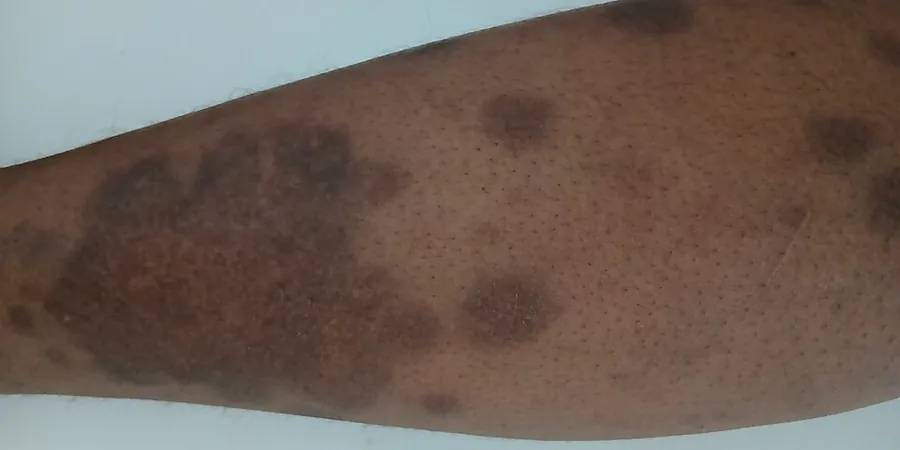

The main sign is dry, thick, raised patches covered with scale that often itch.
Color varies with skin tone: on lighter skin it tends to be red or pink with silvery-white scale; on darker skin it may look violet with gray scale, or dark brown and hard to see.
As it clears on medium to dark skin, lighter or darker patches may remain. These are not scars and fade gradually.
Types of psoriasis
Two rare, serious types need immediate care: generalized pustular psoriasis with fever and weakness, and erythrodermic psoriasis, which makes the skin look burnt with chills and a fast pulse.
| Type | Appearance | Common sites |
|---|---|---|
| Plaque | Thick, raised, scaly patches; the most common type | Scalp, elbows, knees, lower back |
| Guttate | Small, scaly pink bumps that appear suddenly and may clear within weeks | Torso, legs, arms |
| Inverse | Smooth, red, raw-looking patches with little scale; often sore | Armpits, genitals, between the buttocks |
| Pustular | Pus-filled bumps with red, swollen, painful skin | Hands and feet |
| Nail | Tiny dents, discoloration, crumbling or separation of the nail | Fingernails and toenails |
What triggers psoriasis?
Do not stop a prescribed medicine on your own if you suspect it is a trigger; discuss it with the doctor who prescribed it.
- Emotional stress.
- Skin injuries such as cuts and severe sunburn.
- Bacterial infections such as strep throat.
- Certain medicines, such as lithium, prednisone and hydroxychloroquine.
- Cold, dry weather.
- Smoking and heavy drinking.
Psoriasis and joints: what to watch for
Some people with psoriasis develop psoriatic arthritis. Early detection matters because early treatment protects the joints.
- Swollen, tender joints, especially fingers and toes.
- Heel pain.
- Morning stiffness.
How is psoriasis treated?
A dermatologist chooses treatment by psoriasis type, severity, location, impact on daily life, and the patient's other conditions and medicines.
| Category | Examples | When used |
|---|---|---|
| Topical treatments | Corticosteroids, vitamin D analogues, tapinarof, roflumilast, coal tar, salicylic acid | Mild to moderate psoriasis, or alongside other treatment |
| Topical calcineurin inhibitors | Tacrolimus, pimecrolimus | Thin-skinned areas such as the face and folds |
| Phototherapy | Ultraviolet light supervised by a dermatologist | Widespread psoriasis or poor response to creams; not a job for tanning beds |
| Oral medicines | Methotrexate, cyclosporine, acitretin, apremilast, deucravacitinib | Moderate to severe psoriasis; some have key restrictions, such as pregnancy with acitretin |
| Injectable biologics | Several classes, plus lower-cost biosimilars | When other treatments are not enough; life-changing for many patients |
Psoriasis is more than skin
Psoriasis is linked with other conditions that are more common in people who have it, such as psoriatic arthritis, high blood pressure and diabetes, so your doctor may monitor for them.
When to see a doctor urgently
- Widespread pus-filled bumps with fever or weakness.
- Redness over most of the skin that looks burnt, with chills, fever or a fast pulse.
- Joint pain or swelling, or repeated morning stiffness.
Common questions
- Is psoriasis contagious? No. It does not spread through touch, swimming or sex.
- Can it be cured? It is chronic, but current treatments control it well for many patients.
- Do tanning beds help? No. Phototherapy is medically supervised; tanning damages the skin and raises cancer risk.
- Will the patches leave marks? Lighter or darker patches can remain on darker skin after clearing, but they are not scars and fade with time.
Key numbers
- Plaque psoriasis accounts for 80–90% of cases.
- About half of people with plaque psoriasis have nail involvement.
- On darker skin, leftover patches can take 3 to 12 months or longer to fade after clearing.